

Peacefully Bear Arms: USPS, Witnesses & Bill of Lading
Homeownership, Private Law, USPS, Bill of Lading
How Homeowners Peacefully Bear Arms Using USPS, Witnesses, and a Bill of Lading
This article explains, in practical terms, how homeowners are using old‑school private law tools so they do not have to rely solely on a public court system they perceive as deeply compromised. It is based on education and experience shared in the Foreclosure Wars video series and similar teachings. The goal is to show homeowners how to stand in honor, create their own record, and avoid feeding an industry that thrives on controversy. It is educational information only, not legal advice.
Why Many Homeowners No Longer Trust the Public Court System
A growing number of homeowners do not rely on the public court system to protect their homes, families, or rights. In their experience, district attorneys, sheriffs, and even judges have been seen lying under oath or misrepresenting documents in ways that appear deliberate rather than accidental. One commonly cited example involves a judge pointing at a page, claiming to see the word “deed” on it, then handing the document back and no one in the room being able to find that word anywhere. For many observers, that is not a simple mistake; it is seen as fraud and industry protection, not justice.
For those seeking a visual sense of how deep this perceived rot goes, films like Just Mercy offer a sobering portrait. Viewers often describe it not as fiction, but as a mirror of systemic abuse. Similarly, The Big Short exposes how synthetic CDOs and paper games were engineered to keep ordinary people confused while insiders profited. In the foreclosure and mortgage world, homeowners see a parallel in the “mail room excuse”: “We never got your letter; an employee messed up.” These patterns are understood as part of a larger system designed to keep borrowers chasing ghosts while lenders and servicers keep the house, the equity, the time, and the peace of the homeowner.
📌 Key Takeaway: Many homeowners view the modern court system not as a neutral forum for justice, but as a mechanism for preserving financial and legal industries built on controversy.
For these reasons, some homeowners describe the public court system, as it stands in 2026, as corrupted. In their view, it is less about ethics and more about securing an industry. Rather than building their security on what they see as shifting institutional sand, they turn to private law tools that pre‑date the modern court system: Lex Mercatoria (the law of merchants), trust law, and postal jurisdiction. These are sometimes contrasted with what scholars at places like Harvard have started calling “retail law” – a rebranding of long‑standing private contract principles that have quietly existed alongside public courts for centuries.
“Peacefully Bearing Arms” as a Homeowner: What That Really Means
Within the Foreclosure Wars communities, the phrase “peacefully bear arms” does not refer to physical confrontation, shouting matches with sheriffs, or dramatic courtroom showdowns. Instead, it refers to using lawful, documented tools that allow a homeowner to defend property and position without stepping into the public court’s arena. The “arms” in this context are paperwork, witnesses, and postal records so complete that there is no controversy left for a public court to pretend it needs to resolve.
In practical terms, this approach for homeowners typically involves:
Two independent witnesses – real, disinterested adults who observe what goes into each envelope and how it is mailed.
The United States Postal Service (USPS) – a federal‑level postal jurisdiction with its own statutory framework, often compared to a bank’s position “next to” rather than “under” the federal government. Private carriers like UPS or FedEx are viewed as “baby jurisdictions” without the same evidentiary weight.
A Bill of Lading – a cargo manifest or receipt describing what is inside each envelope, tied to specific USPS certified mail tracking numbers, witnessed and signed, forming a third‑party trust record.
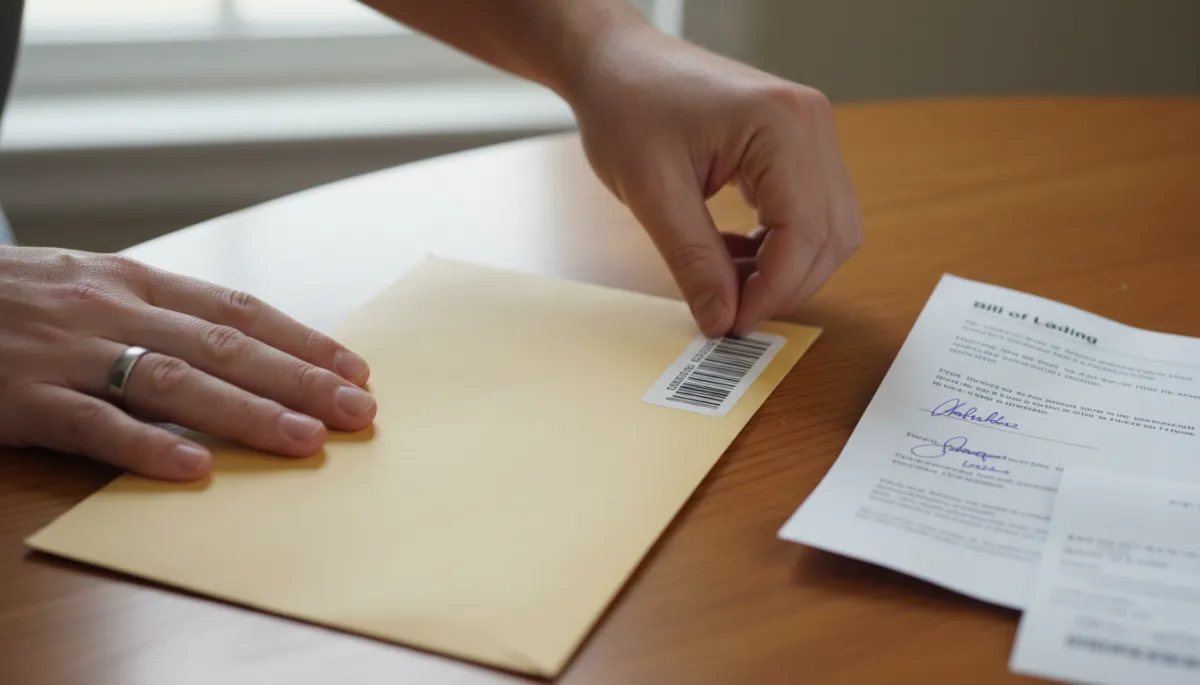
Tying each envelope to a Bill of Lading turns simple mail into structured, evidentiary record.
Why USPS Is Preferred Over Online Shortcuts and Private Carriers
Certified mail labels can be generated online, printed at home, and dropped off with little ceremony. While convenient, that process alone leaves a critical evidentiary gap. USPS certified tracking only proves that something was mailed from point A to point B. It does not prove what was actually placed inside the envelope. That gap is precisely where, according to many homeowners, shysters and fraudsters operate. They can claim, “We never got that notice,” or “What you say you sent is not what we received.”
💡 Pro Tip: Tracking numbers alone are rarely enough. The contents of the envelope must be tied to those numbers through witnesses and documentation.
To close that gap, practitioners of this method combine USPS certified mail with witnesses and a Bill of Lading. The USPS role is to provide a federal postal record: date, time, origin, and destination. The witnesses and Bill of Lading supply the missing piece – what was mailed. Together, they transform a simple mailing into a bona fide private record that can stand on its own, reducing the need for homeowners to appear in public court to “testify” about what they sent, unless serious fraud and forgery is done.
What a Bill of Lading Really Is (And Why Homeowners Use It)
The phrase “Bill of Lading” can sound intimidating, and some attorneys AT law may dismiss it as “just an invoice.” However, the term “bill” is much broader. Consider the Bill of Rights or the “bills” legislatures pass into law. A bill is fundamentally a formal written instrument. In commercial and shipping contexts, a Bill of Lading is a cargo manifest – a written record describing the goods being carried and who they are going to.
In the homeowner’s private law context, the “cargo” is not boxes on a ship but documents: notices, Bills of Exchange, affidavits, personal/private information, and other records. The Bill of Lading becomes the paper that states:
Who is sending which documents,
To which respondent or respondents,
Under which USPS certified mail tracking numbers,
Witnessed and signed by two independent third parties.
Functionally, this Bill of Lading operates as an affidavit of contents. Importantly, in the approach described in the Foreclosure Wars materials, it is not signed by the homeowner who benefits from the mailing. It is signed by third‑party witnesses. This design helps avoid accusations that the homeowner “made it up later” and instead establishes a third‑party trust. When multiple independent parties confirm the same record, there is far less room for a public court to claim there is a genuine controversy that requires its intervention.
Step‑by‑Step: Using a Bill of Lading With USPS and Witnesses
The following steps summarize how this process is typically described to homeowners. It is presented for clarity and education only; each person remains responsible for their own choices and research.
Gather the documents. These may include notices to a bank, servicer, county office, or any party involved with the property. In some approaches, this can also include a Bill of Exchange – treated as a form of United States Dollar payment instrument. The principle asserted is that if a party accepts United States Dollars, a properly executed Bill of Exchange constitutes lawful payment. If that party denies or refuses it, proponents argue that the obligation has still been discharged on the sender’s side; any failure to credit the account becomes the recipient’s issue, not the homeowner’s that now has a third party executed receipt of the transaction/correspondence.
Invite two independent witnesses. These should be adults who are not under the homeowner’s control and who can honestly attest, if ever needed, to what they saw. InPowerMovement materials highlight two‑witness statutes and “higher authority” structures found in various jurisdictions. The Bill of Lading process simply applies those principles to everyday homeowner mailings.
Prepare the Bill of Lading. A homeowner may use a template or craft a simple form. For each respondent, the Bill of Lading typically lists:
– The respondent’s name and mailing address,
– A short description of the documents being sent (for example, “Notice of Claim and Bill of Exchange”),
– A space to record the USPS certified mail tracking number sticker that was assigned to that envelope.Obtain certified mail stickers at the post office. Rather than using regular mail, practitioners of this method almost always use certified mail with electronic return receipt. Each certified mail sticker has a top portion (a narrow strip with the tracking number) and a larger label that adheres to the envelope itself.
Attach tracking numbers to the Bill of Lading. The homeowner peels off the top portion of each certified mail sticker and places it on the Bill of Lading next to the corresponding respondent’s entry. This step ties each recipient to a specific tracking number on a single document. That Bill of Lading then becomes an original record(bill) in the homeowner’s private files.
Pack the envelopes in front of both witnesses. With everyone present at the table, the homeowner:
– Shows the documents,
– Places the correct documents into each labeled envelope (to include copy of signed bill of lading),
The witnesses are not guessing; they are observing exactly which documents go into which envelopes.Apply the certified mail stickers to the envelopes. The larger portion of each sticker is then affixed to its envelope. Some practitioners intentionally place the label so that it wraps over an edge – partly on the front and partly on the back – making any attempt to remove or tamper with it more obvious. These small physical details can matter when dealing with institutions that may resist acknowledging a record.
Have both witnesses sign the Bill of Lading. Once the envelopes are sealed and labeled, the two witnesses sign and date the Bill of Lading, affirming that:
– They saw the documents,
– They watched those documents placed into the correct envelopes,
– They saw the envelopes sealed and labeled with those exact tracking numbers.Make copies for the recipients. The original Bill of Lading remains with the homeowner in private records. Copies are placed inside each envelope so that every respondent can see a description of what was sent and the associated tracking number. This anticipates the classic question, “What did you send?” by embedding the answer directly into the mailing itself.
Obtain a USPS hand‑applied round‑date stamp. At the USPS counter, some clerks may say that the machine‑printed bar code and date are sufficient. Practitioners of this method, however, specifically request the original individual post office's unique date stamp on both the certified receipts and, when possible, on the Bill of Lading(not common). That hand‑applied stamp makes it much harder for anyone to fabricate or alter the record later. If a later “copy” appears with a different stamp, the discrepancy is easier to detect.
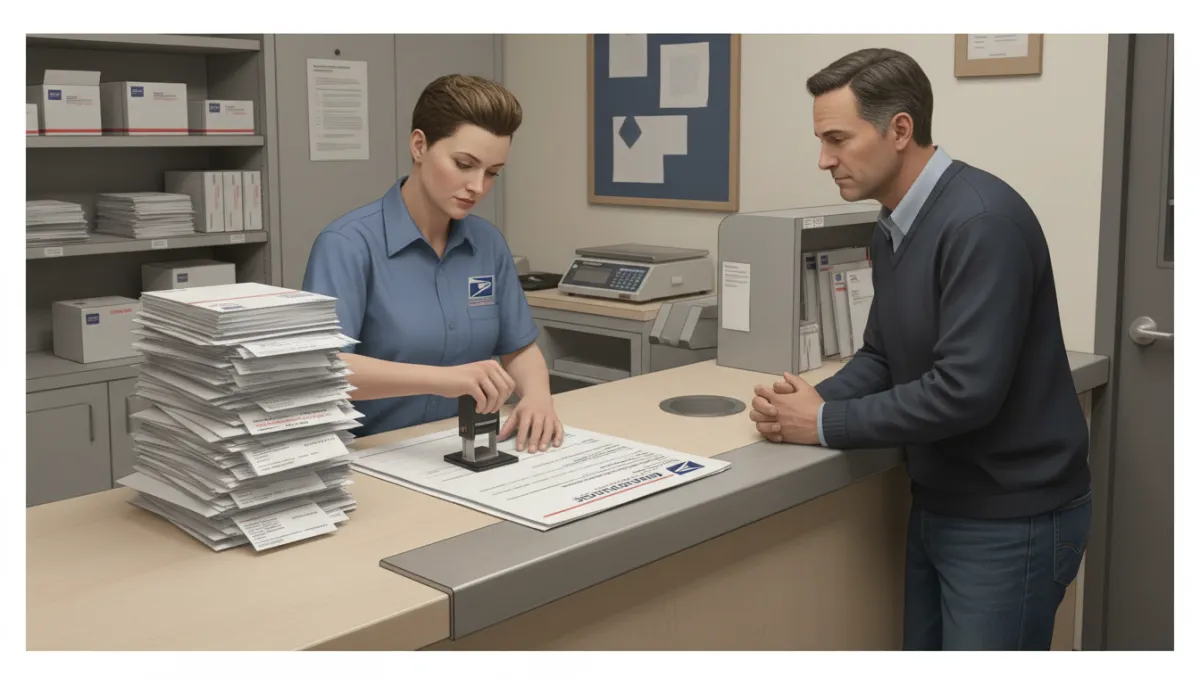
A live USPS round-date stamp helps distinguish the original record from later imitations or disputes.
Building Third‑Party Trust and Closing Common Excuses
After completing this process, a homeowner holds a layered evidentiary package:
Two independent witnesses confirming the contents and the mailing process,
USPS certified tracking showing that each envelope went to the correct address,
Electronic signature or delivery confirmation, supporting the maxim that “notice to agent is notice to principal; notice to principal is notice to agent”,
An original Bill of Lading tying all of these elements into one coherent private record.
“Who controls the record controls the narrative.”
When a bank, servicer, or attorney later claims, “We never received that,” the homeowner is no longer relying on memory or verbal argument(hersey). The witnesses, USPS tracking, electronic receipt, and Bill of Lading form a third‑party trust structure. If someone signed for the mail but claims not to have been an authorized agent, that party and their principal may be stepping into mail fraud territory, not the homeowner. The homeowner’s role is to act in honor, document thoroughly, and avoid unnecessary confrontation.
Old‑School Private Law: Lex Mercatoria, InPowerMovement, and Case Lessons
The approach described here is not a new invention. It draws on Lex Mercatoria, the historical “law of merchants” that governed private contracts and commerce long before modern nation‑states developed their court systems. Many of its concepts are reflected in definitions found in resources like Black’s Law Dictionary. Contemporary legal academics from Harvard are attempting to repackage aspects of this tradition as “retail law,” but the underlying principles are centuries old: private parties can structure their own contracts and records, and those records can carry significant weight.
Groups such as the InPowerMovement focus on surfacing statutes and case law that support these ideas, including two‑witness rules and hierarchies of authority. Their materials encourage homeowners to locate tools that have been “hiding in plain sight” within existing lawful frameworks. The Bill of Lading and USPS process is one way some homeowners apply those principles in daily life, keeping as much of their affairs as possible within private law rather than public court processes.
Historical examples reinforce this tension between centralized financial control and private contract rights. Andrew Jackson, for instance, vehemently opposed the type of central bank note system later associated with the Federal Reserve’s Notes. Many observers see the placement of his portrait on such notes as ironic, even insulting, given his resistance to centralized monetary power. That same tension surfaces today when homeowners explore Bills of Exchange and other private contract instruments to settle debts in a system that often pretends only one narrow form of “legal tender” is lawfully valid, so long as it keeps borrowers dependent.
Cases like Heinz v. North Carolina are sometimes studied in these circles not as magic bullets, but as illustrations of how jurisdiction, procedure, and record‑keeping can either empower or corner an individual in a process. The central lesson many draw is that the party who controls the record tends to control the narrative. By using a Bill of Lading, witnesses, USPS certified mail, and clear documentation, homeowners aim to create a record that “speaks for itself” long before any courtroom appearance(controversy) is even contemplated.
Educational Purpose and Important Disclaimer
Many homeowners are searching for ways to protect their homes without walking blindly into a system they experience as adversarial and profit‑driven. The methods described here – two witnesses, USPS certified mail, Bills of Lading, Bills of Exchange, and private contract principles rooted in Lex Mercatoria – are part of that exploration. They represent one educational perspective on how to reduce reliance on public courts and to build stronger private records.
⚠️ Warning: Misunderstanding or misapplying law or legal concepts can have serious consequences. Always research thoroughly and consult qualified professionals where appropriate/needed.
However, it is crucial to be clear about the nature of this information. This article is not written by an attorney and does not provide legal or lawful advice. It summarizes educational content and personal experiences shared in foreclosure‑focused communities such as Foreclosure Wars and the InPowerMovement. Every reader remains responsible for their own research, decisions, and outcomes. Those who wish to go deeper should study statutes, case law, Lex Mercatoria, and reputable educational materials, verifying every claim for themselves.
In summary, the Bill of Lading process, combined with USPS certified mail, two independent witnesses, and careful documentation, is presented by its proponents as a powerful way for homeowners to “peacefully bear arms” in the legal and commercial realm. It aims to bind facts in the tangible, three‑dimensional world in a way that also establishes trust and clarity in the abstract realm of records and rights. Used thoughtfully and in honor, it can help shrink controversy and reduce the need for public courts to “decide” a homeowner’s reality on loose or missing records.
Disclaimer: This entire article is for educational purposes only. It reflects concepts and experiences shared in private law and homeowner education communities. It does not constitute legal or lawful advice, does not create any attorney‑client relationship, and should not be relied upon as a substitute for professional counsel.


